STARS
By Yoonang Bustarde - March 22, 2018

STAR is type of astronomical object consisting of a luminous spheroid of plasma held together by its own gravity. The nearest star to Earth is the Sun. Many other stars are visible to the naked eye from Earth during the night, appearing as a multitude of fixed luminous points in the sky due to their immense distance from Earth.
APPEARANCE
Some stars have always stood out from the rest. Their brightness is a factor of how much energy they put out–known as luminosity–and how far away from Earth they are. Stars in the heavens may also appear to be different colors because their temperatures are not all the same. Hot stars are white or blue, whereas cooler stars appear to have orange or red hues.
History of observations
Since the dawn of recorded civilization, stars played a key role in religion and proved vital to navigation. Astronomy, the study of the heavens, may be the most ancient of the sciences. The invention of the telescope and the discovery of the laws of motion and gravity in the 17th century prompted the realization that stars were just like the sun, all obeying the same laws of physics. In the 19th century, photography and spectroscopy — the study of the wavelengths of light that objects emit — made it possible to investigate the compositions and motions of stars from afar, leading to the development of astrophysics.
In 1937, the first radio telescope was built, enabling astronomers to detect otherwise invisible radiation from stars. The first gamma-ray telescope launched in 1961, pioneering the study of star explosions (supernovae). Also in the 1960s, astronomers commenced infrared observations using balloon-borne telescopes, gathering information about stars and other objects based on their heat emissions; the first infrared telescope (the Infrared Astronomical Satellite) launched in 1983.
Star formation

Constellations
a group of stars forming a recognizable pattern that is traditionally named after its apparent form or identified with a mythological figure. Modern astronomers divide the sky into eighty-eight constellations with defined boundaries.
Aquarius

This drawing, as well as those below, is from Sidney Hall’s set of drawings called Urania’s Mirror. Published in 1824, the set contains 32 star chart cards depicting 79 constellations, many of which are no longer recognized or are considered sub-constellations. The illustrations are based on what’s viewable from Great Britain, making them fairly similar to what you’d see in the States.
While one of the biggest, most famous, and oldest named constellations, Aquarius is faint and often hard to find/see. In Greek mythology, Aquarius represented Ganymede, a very handsome young man. Zeus recognized the lad’s good looks, and invited Ganymede to Mt. Olympus to be the cupbearer of the gods. For his service he was granted eternal youth, as well as a place in the night sky.

Aquila
Delphinus, on the left, is still a recognized constellation, but quite small and faint. Sagitta, the bow and arrow, is considered an ancient constellation.
Aquila was the eagle that in Greek mythology actually bore Ganymede (Aquarius) up to Mt. Olympus. The eagle was also the thunderbolt carrier for Zeus.

This constellation lies in the Milky Way band, and its most prominent star is Altair, which is actually one of the closest naked eye stars to the earth. The top portion of Aquila forms a shallow inverted “V,” with Altair nearly the point. This represents the head and wings of the eagle. A line then descends from Altair, which forms the body of the eagle.
Look towards the southern sky in the late summer, near the Milky Way band, for Aquila.
Aries
 Musca Borealis, the bee, is a discarded constellation.
While many constellations have gone through various iterations of mythological stories, Aries has always been the ram. This constellation is one of 12 constellations that form the zodiac — the constellations that straddle the sun’s path across the sky (known in scienctific terms as the ecliptic). In ancient times, that gave the constellations of the zodiac special significance.
In Greek mythology, Aries is the ram whose fleece became the Golden Fleece. The Golden Fleece is a symbol of kingship and authority, and plays a significant role in the tale of Jason and the Argonauts. Jason is sent to find the fleece in order to rightfully claim his throne as king, and with some help from Medea (his future wife), finds his prize. It’s one of the oldest stories in antiquity, and was current in Homer’s time.
Musca Borealis, the bee, is a discarded constellation.
While many constellations have gone through various iterations of mythological stories, Aries has always been the ram. This constellation is one of 12 constellations that form the zodiac — the constellations that straddle the sun’s path across the sky (known in scienctific terms as the ecliptic). In ancient times, that gave the constellations of the zodiac special significance.
In Greek mythology, Aries is the ram whose fleece became the Golden Fleece. The Golden Fleece is a symbol of kingship and authority, and plays a significant role in the tale of Jason and the Argonauts. Jason is sent to find the fleece in order to rightfully claim his throne as king, and with some help from Medea (his future wife), finds his prize. It’s one of the oldest stories in antiquity, and was current in Homer’s time.
 Aries is formed by just 4 (sometimes 5) visible stars, which create a line from the ram’s head (the lowest point in the image above) and down its back. Hamal is the largest and most visible star, and is classified as an orange giant.
Gemini


Aries is formed by just 4 (sometimes 5) visible stars, which create a line from the ram’s head (the lowest point in the image above) and down its back. Hamal is the largest and most visible star, and is classified as an orange giant.

Latin for “twins”
Best viewed in: February
Best viewed in: February
Gemini represents the twins Castor and Pollux. While the twins’ mother was Leda, Castor’s father was the mortal king of Sparta, while Pollux’s father was King Zeus (He seduced Leda in the form of a swan, remember? These stories tend to all tie together!). When Castor was killed, the immortal Pollux begged Zeus to give Castor immortality, which he did by placing the brothers in the night sky for all time.
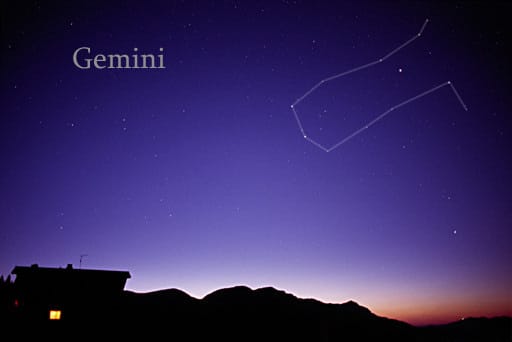
Castor and Pollux also happen to be the names of the brightest stars in the constellation, and represent the heads of the twins. Each star then has a line forming their bodies, giving the constellation a rough “U” shape. The twins sit next to Orion, making them fairly easy to find in winter.
Leo
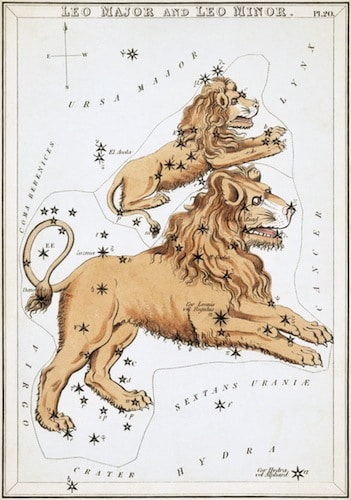
Leo Minor is a recognized constellation, but is so small and faint that Ptolemy didn’t include it in his original list. To this day, Leo Major is solely regarded as “Leo.”
Latin for “lion”
Best viewed in: April
Best viewed in: April
Leo has been a great lion in the night sky across almost all mythological traditions. In Greek lore, Leo is the monstrous lion that was killed by Hercules as part of his twelve labors. The lion could not be killed by mortal weapons, as its fur was impervious to attack, and its claws sharper than any human sword. Eventually Hercules tracked him down and strangled the great beast, albeit losing a finger in the process.
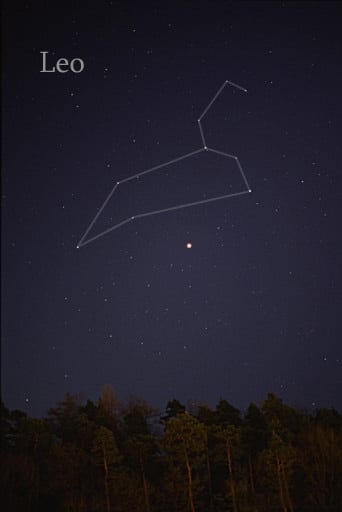
Because Leo actually looks somewhat like its namesake, it is the easiest constellation in the zodiac to find. A distinctive backwards question mark forms the head and chest, then moves to the left to form a triangle and the lion’s rear end. Regulus is Leo’s brightest star, and sits in the bottom right of the constellation, representing the lion’s front right leg.
Scorpius
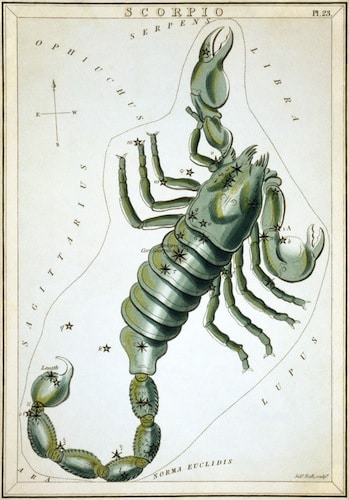
Scorpius is sometimes also known as just Scorpio.
Latin for “scorpion”
Best viewed in: July
Best viewed in: July
There are a variety of myths associated with the scorpion, almost all of them involving Orion the hunter. Orion once boasted that he could kill all the animals on the earth. He encountered the scorpion, and after a long, fierce fight, Orion was defeated. It was such a hard-fought battle that it caught the eye of Zeus, and the scorpion was raised to the night sky for all eternity.
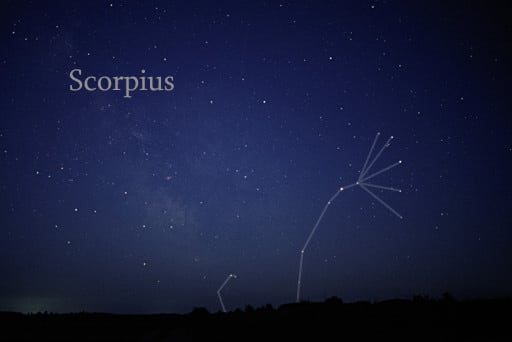
With many bright stars, Scorpius is fairly easy to find in the night sky. Antares, the brightest star in the constellation, is said to be the heart of the scorpion. That will be the easiest star to locate, but is sometimes confused with Mars because of its red-orange coloring. To the right of the heart are 3-5 stars that form the head. To the left are a long line of stars that curve into a sideways or upside-down question mark.
Pisces
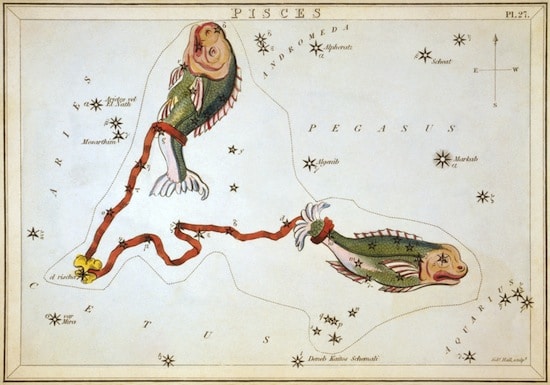
Latin for “fish” (plural)
Best viewed in: November
Best viewed in: November
The two fish of the sky represent Aphrodite and her son Eros, who turned themselves into fish and tied themselves together with rope in order to escape Typhon, the largest and most vile monster in all of Greek mythology.
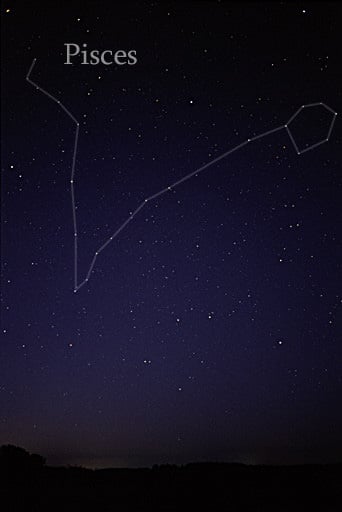
It’s not likely you’ll find Pisces in the middle of a city, as none of its individual stars are really worth noting or particularly bright. It forms a large “V” with the right fish forming a small “O” on the end, and the left fish forming a small triangle on the end (the image above doesn’t connect the dots in the upper left to make it a triangle).
It is not in the stars to hold our destiny but
in ourselves. -William Shakespeare


11 (mga) komento
Do you like stars?
ReplyDeleteWhat are stars mad of ?
ReplyDeleteBasically, stars are big exploding balls of gas, mostly hydrogen and helium. Our nearest star, the Sun, is so hot that the huge amount of hydrogen is undergoing a constant star-wide nuclear reaction, like in a hydrogen bomb.
DeleteIf stars are formed and born, do they also die or disappear?
ReplyDeleteYes,They die because of a tremendous supernova explosion which occurs when the star runs out of nuclear fuel.
Deletebakit may iba't ibang klase pa ng mga bituin kung pare pareho lang din namang tinatagwag na bituin?
ReplyDeleteWhat are you trying to ask is the constellations actually they are all stars but the scientist give it a name.
DeleteBakit sa ibang gabi wala akong nakikitang bituin?
ReplyDeleteit's beacause of Light pollution. Light Pollution affects primarily the observations of faint objects, such as distant galaxies. Bright objects such as the Moon, the big planets, or some of the bright stars, are not affected by light pollution.
Deletewhat is the meaning of celestial sphere?
ReplyDeletecelestial sphere is an abstract sphere, with an arbitrarily large radius, that is concentric to Earth. All objects in the sky can be conceived as being projected upon the inner surface of the celestial sphere, which may be centered on Earth or the observer. If centered on the observer, half of the sphere would resemble a hemispherical screen over the observing location. The celestial sphere is a practical tool for spherical astronomy, allowing astronomers to specify the apparent positions of objects in the sky if their distances are unknown or irrelevant.
Delete